Tyndall's Programmable Microchip Research Points Towards Lower-Power 6G HardwareAn international team involving Cork researchers has integrated switches that retain their configuration without continuous power into high-frequency communication circuits.
“Low standby power is not the same as zero network power.”
Researchers at Tyndall National Institute in Cork have contributed to a new approach to programmable wireless microchips. Announced by Tyndall on 22 September, the research combines novel switches with high-frequency communication circuits, allowing the switches to retain their configuration without a continuous power supply. The work offers a specific hardware advance with potential relevance to future 6G and satellite communications.
The study, published in Nature, is not the launch of an Irish 6G network or a finished chip in a consumer phone. It is research demonstrating how a new type of switching component can be integrated into functioning communication circuits. That moves the story beyond the performance of an isolated material and towards the engineering needed for a useful system.
Its significance is also different from an announcement about building a new semiconductor factory. This is a device and circuit research story: how materials can be combined to make wireless hardware more adaptable, and how settings can be retained with very little standby power. The Irish contribution sits within an international team working on that concrete technical problem.
Why Wireless Hardware Needs to Adapt
Wireless communication depends on circuits that handle signals at particular frequencies and perform jobs such as controlling signal strength or routing energy. As researchers develop future systems, flexibility matters alongside raw speed. Hardware that can be reconfigured offers a way to change behaviour without designing a separate fixed circuit for every setting.
Switches are a key part of that flexibility. A switch changes the electrical route or state of a circuit, allowing the system to behave differently. In this study, the researchers use switches designed to retain a selected state. That memory-like characteristic is why their power requirements can differ from components that need a continuing input to maintain a setting.
Tyndall describes the work as a step towards high-performance, adaptable wireless hardware. The relevant applications include future terrestrial and satellite communication systems. Those are potential destinations for the research, not evidence that the components are already operating in a deployed 6G service. A circuit demonstration and a complete communications network are very different scales of achievement.
The technical advance is still useful at its own scale. Future systems depend on many component-level decisions, including what can be programmed, how much signal is lost and what energy is needed to maintain an operating state. Research that addresses those questions supplies building blocks. It need not be a complete consumer product to make a meaningful contribution.
The word programmable should also be read carefully. It means that a circuit's behaviour can be configured; it does not establish that the chip independently understands network demand or makes human-like decisions. Control software and wider system design are separate layers. Keeping that distinction visible makes it easier to see what this study adds: a physical means of changing and retaining circuit settings, not an entire intelligent network compressed into one component.
Two Materials, One Integrated Circuit
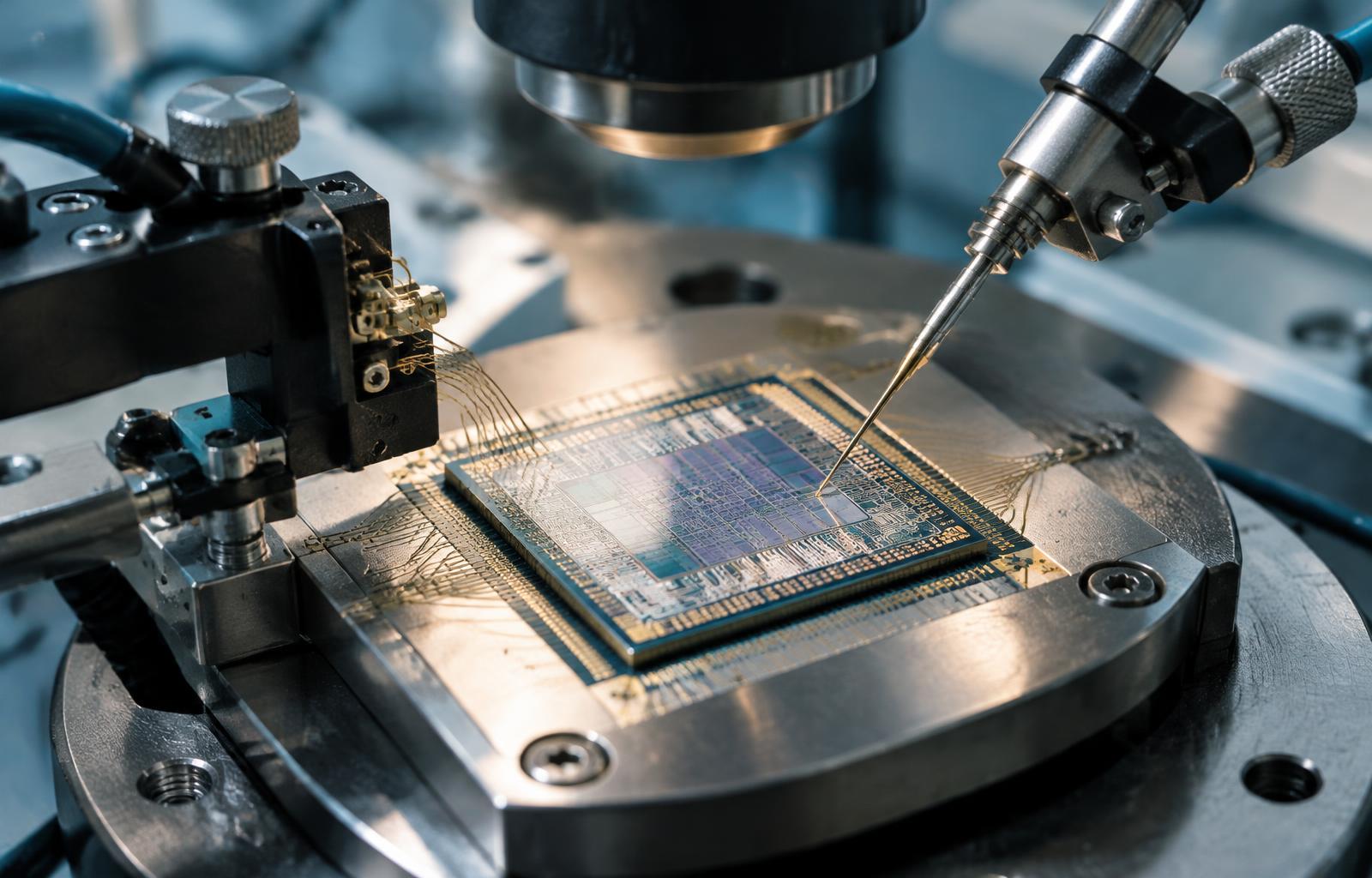
The study combines switches made from multilayer hexagonal boron nitride with gallium nitride microwave integrated circuits. Hexagonal boron nitride is a layered material; gallium nitride provides the platform for the high-frequency circuits used in the work. The abbreviations can obscure the practical point: the team is integrating a new kind of programmable switch into a circuit technology suited to demanding radio-frequency tasks.
The switches are described as memristive and non-volatile. Here, the important property is that their selected electrical state can persist without continuous power to hold it. The Nature abstract reports state retention over two weeks in the tests described. That is a measured experimental characteristic, not a guarantee that every possible product will preserve its settings indefinitely under every condition.
The Nature paper also reports wideband switches operating up to 100 gigahertz, along with demonstrations in configurable attenuators, power dividers and resonators. An attenuator controls signal strength; a power divider splits a signal; a resonator responds to selected frequencies. These examples show the switches being used in recognisable circuit functions, rather than remaining only a laboratory material sample.
That integration is central to the story. A promising component has to connect with the rest of a system to become useful. The researchers demonstrate several applications within the circuit platform, giving subsequent work a basis for exploring design and performance. It would go beyond the evidence to claim that the study has already solved every reliability, manufacturing and system-level requirement for commercial wireless equipment.
Low Standby Power Is Not Zero Network Power
Tyndall's announcement emphasises almost no standby power and the ability to retain a configuration without continuous power. That should not be rewritten as a claim that a complete microchip or wireless network consumes no energy. Maintaining a switch setting is one operation. Transmitting, receiving and processing signals involve other components and other power demands.
The distinction matters because energy claims can become much broader as a story is retold. A component that retains its state efficiently can be valuable, but the announcement does not provide a verified percentage reduction in the electricity consumption of a deployed network. It also does not establish a corresponding saving on a household bill or a measured extension to the battery life of a consumer device.
A more useful explanation is that the research tackles one source of energy use while also supporting reconfiguration. The two properties are connected: the hardware can be set to behave differently, and the selected switch state does not need continuous power simply to remain selected. Researchers can then examine how that characteristic fits into larger circuit and system designs.
This is a strong deep-tech angle precisely because it is specific. Instead of a vague claim that the next generation of connectivity will be greener, the work identifies a physical mechanism and demonstrates its use in communication circuits. That gives the potential benefit an engineering basis, while leaving full-system energy savings to be established through further design and measurement.
Cork's Contribution to an International Effort
Tyndall's announcement names Professor Dimitra Psychogiou, head of its Advanced Technologies Group, and senior postdoctoral researcher Andrés Fontana. Professor Psychogiou is supported through a Research Ireland Research Professorship Award and the CONNECT Research Ireland Centre. Their comments place the work within continuing research on radio-frequency and semiconductor technologies for adaptable communications.
The international team spans Tyndall, UCC, the National University of Singapore, Universidad Tecnológica Nacional in Buenos Aires and King Abdullah University of Science and Technology. Tyndall identifies funding from Research Ireland, Singapore's National Research Foundation and KAUST. That makes the Irish role a contribution to collaborative research, not an exclusively Cork invention developed without international partners.
For Ireland, the relevance is the capability to participate at the level of materials, device engineering and circuit integration. Those are parts of the semiconductor value chain that are less visible than a factory opening but important to what future hardware can do. The research offers a distinct example of that capability, with a published study and identifiable circuit demonstrations behind it.
The next stage is to build on those results, examine their limits and explore how the components fit into more demanding systems. The sources do not announce mass production, a named commercial customer or a timetable for a consumer launch. What they establish is a research advance that brings programmable low-standby-power switches into functioning high-frequency circuits. That is the right foundation for assessing what comes next.
The Bottom Line
The Tyndall-linked study demonstrates an integrated approach to programmable wireless circuits using switches that retain their state without continuous power. Its potential relevance to future 6G and satellite systems is grounded in specific materials and circuit results, not a claim of a deployed network or zero-energy communications. For Ireland, it is a substantive example of Cork research contributing to international semiconductor development. The opportunity lies in turning that component-level progress into increasingly capable systems, with wider benefits established through testing.
AI & Innovation Pulse is an independent Irish digital title covering artificial intelligence and innovation. Every piece is written in-house, editorially independent, and verified.