Irish Engineering Firm Strata Puts AI to Work on Construction PlanningMore than 100 construction simulations in 2026 put a Dublin engineering firm’s data-driven approach to planning in focus.
“The opportunity is better-informed engineering judgement, not a promise that an early warning automatically prevents a delay.”
Strata’s approach to AI starts with a familiar engineering problem: understanding what might go wrong early enough to make a better decision. Its experience offers a practical example of a specialist business building technology around its own work, rather than treating AI as a separate product in search of a use.
The detailed evidence comes from an Enterprise Ireland case study published on 27 August. An October update adds a useful current marker: in a company LinkedIn post dated 27 October, Strata said its team had delivered more than 100 4D simulations during the year. That supports a picture of active delivery. It does not establish a new set of AI performance results beyond those reported in August.
From everyday tools to engineering intelligence
Strata provides project controls and digital construction services for complex projects. Enterprise Ireland’s August account describes a business founded in 2016 with more than 70 people across Ireland, the UK, Sweden and Brazil. Its work includes healthcare, infrastructure, transport, energy and data centres. These are settings where the order and timing of work can matter as much as the design itself.
According to operations director Melissa Sheridan in that account, the company’s AI adoption developed in stages. Staff first used readily available tools, including Copilot and Claude, for work such as creating content and finding documents. Internal AI agents then made company knowledge easier to access. Only after that did Strata apply AI and machine learning to historical project information to identify patterns, risks and planning opportunities.
That sequence matters commercially. It gave the business a progression from individual productivity to shared knowledge and then to analysis embedded in its specialist services. Other engineering firms do not need to reproduce the same tools. The transferable lesson is to build familiarity and useful data practices before expecting an analytical system to influence complicated project decisions.
Specialist staffing also helped. Enterprise Ireland says Strata brought in an AI engineer in 2025 through a 12-month CeADAR Work Ready Graduate Training Programme placement, then made the role permanent when the placement ended in early 2026. The detail is important: technical capability became part of the organisation. It was not simply a tool handed over to engineers with an instruction to find savings.
What the August figures actually measure
The August case study reports planning durations reduced by up to 18%, critical risks identified 10–20 days earlier and engineer utilisation improved by around 20%. These are company-reported results presented by Enterprise Ireland, not independently audited findings. They are still useful indicators of where Strata sees value, provided each measure retains its original meaning and qualifications.
Shorter planning durations are not the same as shorter construction programmes or buildings completed earlier. The figure concerns planning, and the words ‘up to’ describe a maximum reported improvement rather than a guaranteed average. A contractor assessing the relevance to its own work would need to understand the starting process, the project mix and how the duration was measured.
Earlier risk identification is similarly distinct from prevention. An additional warning window could give a team time to examine alternative sequences, discuss resources or investigate a dependency. Whether it avoids a delay depends on the response and on what can realistically be changed. The reported interval does not show that every flagged risk was prevented or that all projects gained that amount of time.
Engineer utilisation needs care too. Around 20% improvement is the reported figure, but the account does not provide enough methodological detail to translate it into a universal saving or a headcount reduction. The case study also reports 33% year-on-year business growth as context. It does not establish that AI caused that growth, and it does not disclose the latest FY2025 or year-to-date financial results.
An October update, not a fresh results claim
Strata Nucleus sits at the centre of the company’s analytical approach. In the August case study, Sheridan says Strata works on about 80 projects a month across Europe, bringing the data together and applying machine learning to help inform future projects. That is a description of activity feeding the platform, not a count of projects independently assessed for the reported performance improvements.
The October company post describes Nucleus as a construction intelligence platform that brings structure, consistency and AI-driven insight to programme data. It says the platform helps teams understand performance, spot emerging issues and turn complex information into actionable decisions. Those are Strata’s descriptions of what the system is intended to help project teams do, rather than newly quantified evidence of its effectiveness.
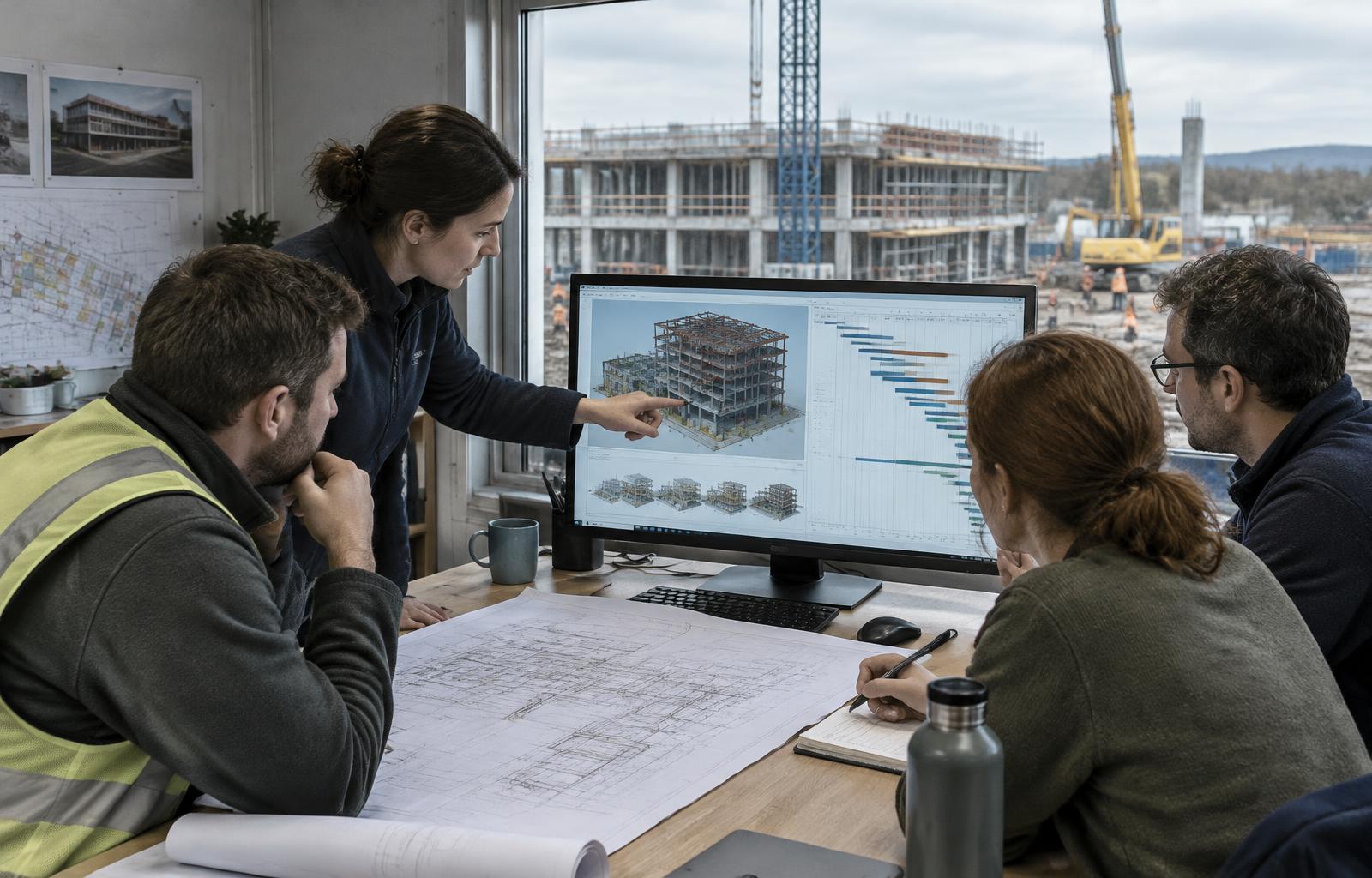
The same post says the team delivered more than 100 4D simulations that year across airports, ports, data centres, highways and other projects. In straightforward terms, 4D visualisation links the representation of a project with time, allowing teams to examine how work is expected to unfold. The August case study separately describes AI-enabled automation in Strata’s 4D visualisation platform, speeding the creation of construction animations.
These details belong together, but should not be collapsed into a stronger claim. The October simulation count is evidence of reported output, not proof that each simulation used AI or achieved the August improvements. Nor does it establish a newer performance benchmark. The update makes an August adoption case current through October activity while leaving the original results, their timing and their limitations intact.
Engineering judgement remains the constraint
The commercial attraction of project intelligence is earlier, better-informed discussion. Its usefulness depends on the quality of the underlying programme and the relevance of historical examples. A model trained on one set of conditions may encounter another project with different access restrictions, procurement pressures or sequencing requirements. Similar-looking data does not guarantee that the engineering problem is the same.
That makes data preparation part of engineering quality, not merely an administrative task. Teams need consistent meanings for activities and progress, and a way to distinguish a genuine change on site from an incomplete update. These are practical requirements for evaluating systems of this kind, rather than assertions about particular controls Strata has disclosed. Without them, an early warning can be precise in appearance but weak in substance.
A useful alert also needs an owner. Someone must decide whether it is credible, what investigation is needed and whether the programme should change. Too many low-value warnings can distract from important ones; too few can create false confidence. Businesses considering similar tools should ask about missed issues and unnecessary alerts as well as the headline examples in which a risk was spotted earlier.
Sheridan’s wider lesson is that leadership, communication, change management and clear objectives determine whether AI delivers value. Her description of success as 80% people and 20% technology is best understood as a management judgement, not a measured allocation of costs or effort. Her emphasis on engineers challenging AI-generated analysis is especially relevant where decisions must remain workable and defensible on real construction sites.
A focused pilot should therefore record what the team knew before an alert, what changed afterwards and whether the response was useful. Keeping that decision trail would make later evaluation more credible. It would also help distinguish the contribution of the analytical tool from the contribution of experienced staff who interpreted and acted on it.
The Bottom Line
Strata offers an encouraging example of AI adoption grounded in a specialist service: build familiarity, bring expertise inside the business, organise project information and use analysis to support professional judgement. The reported August improvements give that approach practical interest. The October statement about more than 100 simulations adds evidence of delivery activity without turning it into an unverified new AI success story.
For other engineering businesses, the useful question is not whether to copy the platform. It is which planning decision could improve with better information, how that improvement would be measured and who would remain accountable. Strata’s case points towards a disciplined answer: use technology to make experienced people better informed, while keeping the boundary between an analytical warning and a verified engineering decision clear.
AI & Innovation Pulse is an independent Irish digital title covering artificial intelligence and innovation. Every piece is written in-house, editorially independent, and verified.