Irish-Founded Manna Expands US Drone Delivery: From Dublin Experience to Tulsa GrowthThree additional Tulsa bases and US aircraft production mark the next step for an Irish-founded business turning flying robots into an everyday service.
“Commercial robotics grows through working locations, reliable processes and repeat customers.”
An Irish-founded robotics business is taking another step into the American delivery market. Manna Air Delivery announced on 13 October that it was adding three operational bases in Tulsa, Oklahoma, alongside a growing US manufacturing footprint. The company says its first batch of American-built aircraft is already in production. It is a story about exporting a working service, not simply showing off a machine that can fly.
The distinction is important. Drone delivery becomes commercially interesting when a customer can use it to order something from a local business, receive that order and choose to do so again. Manna's initial Tulsa service, announced in August, gives the October expansion an operating foundation. The additional bases are a further step towards the company's wider American ambitions, rather than evidence that those ambitions have already been completed.
For Ireland, the connection goes beyond a founder's nationality. Manna's experience includes a delivery partnership in Dublin, where Deliveroo announced a Manna-powered service in Blanchardstown in June 2025. Its move in Tulsa brings that practical operating background into a different market, with different neighbourhoods, merchants and requirements.
A Delivery Service, Not Just a Flying Demonstration
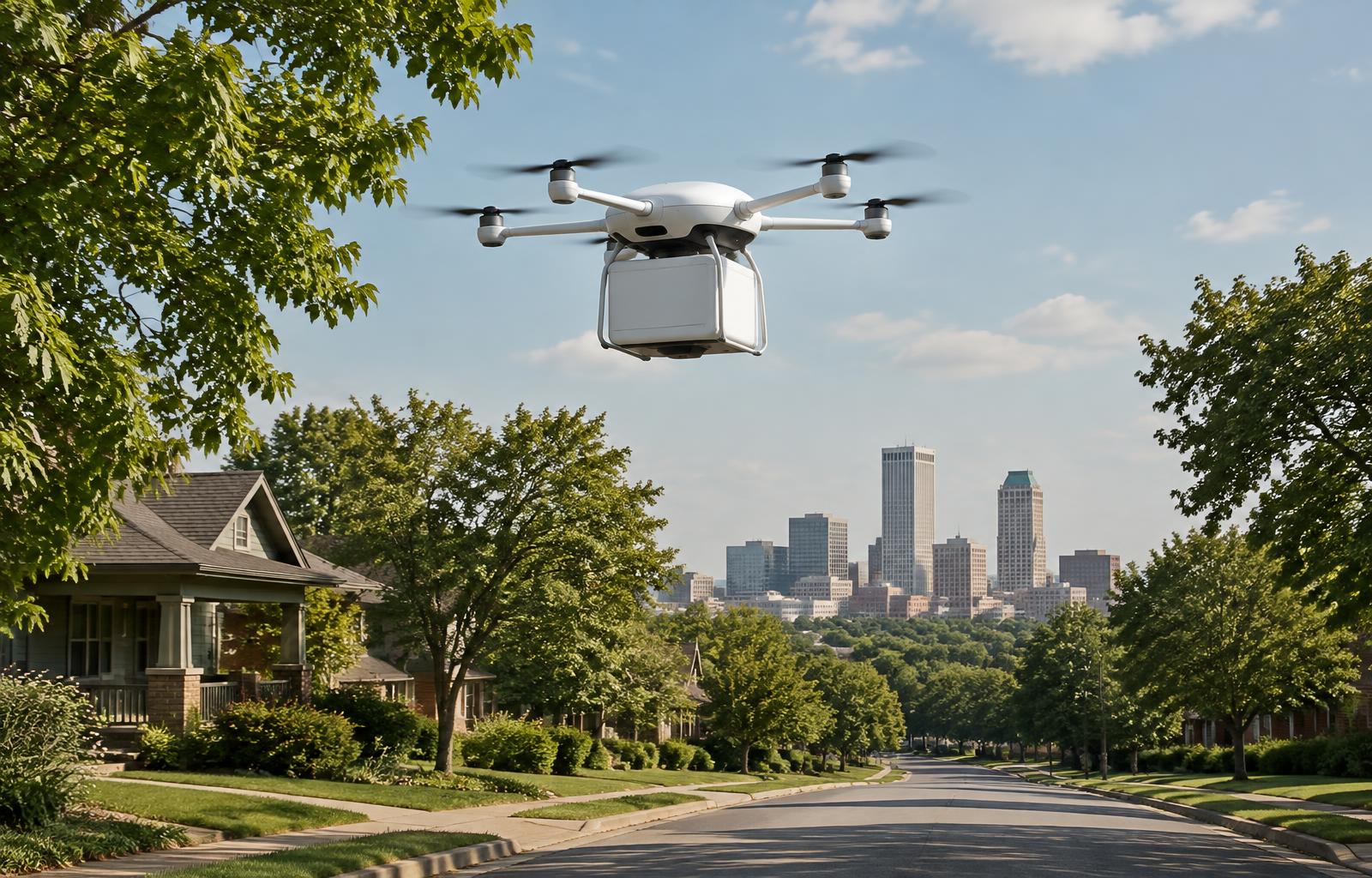
The customer-facing idea is deliberately ordinary. People in an eligible service area order through the Manna app, select a delivery location and receive food or other suitable everyday items from participating local businesses. The aircraft carries the order through the air, hovers above the delivery point and lowers it on a tether. It then returns to base. It does not have to land in the customer's garden.
That final step helps explain what separates delivery robotics from conventional delivery. There is an aircraft, but there is also an ordering system, a collection point, a destination that can receive a package and a process for sending the vehicle back into service. The flying robot is one part of a connected operation. A successful customer experience depends on the whole chain working together.
Manna's August Tulsa announcement identified its initial base near Cherry Street at 1631 East 15th Street. It described three delivery aircraft and an initial two-mile service radius. Andolini's Pizzeria, Paréa Coffee and Sapori were among the named launch businesses. These details give the expansion a concrete starting point: a local service tied to identifiable merchants and a defined area, rather than an abstract promise of nationwide coverage.
The opening announcement also described a gradual ramp-up in operating hours. That is a useful reminder that a commercial launch and a fully expanded schedule are not the same thing. The October release adds further bases to the story, but it does not establish the opening date, address and live ordering availability of every new location. The supported news is the company's expansion announcement, with a commercial service already launched in Tulsa.
What Three More Bases Can Change
Each of the three additional Tulsa bases has capacity for up to 24 deliveries per hour, according to Manna. Capacity describes what the operation is designed to handle. It is not a report that each base is completing that many orders every hour, and it should not be read as a measured daily sales total. Demand, merchant participation, operating conditions and the schedule still determine what happens in practice.
The base model matters because delivery is geographically specific. A customer must be within an eligible area, an order must be suitable for the aircraft and a participating business must be available. Adding locations is therefore a way to extend a service through local coverage, rather than assuming a single launch can reach an entire city. The model offers a practical route for expansion while keeping the customer experience rooted in nearby businesses.
For a restaurant or shop, the potential attraction is another channel for serving local customers. For the customer, it is a different way to receive an everyday purchase. Neither benefit requires treating drones as a replacement for every van, rider or car. Some goods and journeys will suit this model better than others. The commercial question is where the service is useful enough to become a repeat choice.
Manna says it has completed almost 400,000 commercial delivery flights over seven years. That is a company-reported cumulative figure, not a Tulsa-only total, and a flight count should not be relabelled as a count of unique customers. Even with those boundaries, it gives context to the business's emphasis on operating experience: the expansion is being presented as the next stage of an existing delivery operation.
Building Aircraft and an American Footprint
The October announcement describes more than local service growth. Manna says its first batch of aircraft built in the United States is in production and that it plans a significant network of high-capacity bases across several states, including Oklahoma and Texas. That combines an operating ambition with a manufacturing one: supplying aircraft for a larger service while building the local organisation needed to run it.
Manna also sets out plans for more than 1,000 American high-spec manufacturing jobs over three years. That is a hiring ambition, not a verified present-day workforce count. The announcement does not establish that all those roles have been created, nor that all planned facilities are complete. Keeping the distinction visible makes the story more useful: readers can recognise the scale of the proposed commitment without mistaking a programme for a finished result.
Local production is significant because commercial robotics has to move beyond making a handful of impressive prototypes. An expanding operation needs aircraft that can be supplied, maintained and supported repeatedly. Manufacturing and service growth are closely connected in that respect. The release does not provide enough detail to calculate production volumes or costs, but it does establish that the company describes aircraft production as already under way.
Founder and chief executive Bobby Healy presents Tulsa as the beginning of a wider delivery network. Executive chairman and president Kenny Jacobs similarly emphasises building aircraft and expanding operations in America. Their statements are useful as an account of the company's direction. They are not independent proof that the network already reaches millions of homes. That remains the ambition against which future operational updates can be assessed.
Why This Is an Irish Robotics Story
Manna provides a clear example of robotics reaching the level of a service business. The technology is not being sold only as a device; it is being used to move goods between businesses and customers. That makes the story relevant to Irish founders building physical technology, to retailers considering new delivery options and to investors assessing how an engineering product can become a repeatable commercial operation.
The Dublin connection supplies a useful piece of that development. Deliveroo's June 2025 announcement described a Blanchardstown test phase for customers within roughly three kilometres. It does not establish nationwide Irish availability, and the Tulsa expansion does not by itself announce additional Irish jobs. What it does show is an Irish-founded company using experience from real local delivery as it expands abroad.
The next meaningful milestones are practical: where additional bases open, which businesses participate, how service availability develops and what aircraft production delivers. Those questions need not detract from the achievement. They are the natural measures of a business moving from an initial market entry towards a larger operation. Commercial robotics becomes convincing through that accumulation of working locations, reliable processes and repeat customers.
There is also a broader lesson in the familiarity of the task. Manna is applying autonomy to food and everyday essentials rather than asking people to adopt an entirely new habit. The technology is advanced, but the customer need is easy to understand. That combination gives this Irish-founded expansion a stronger business story than a flight demonstration alone could provide.
The Bottom Line
Manna's additional Tulsa bases and reported US aircraft production mark a substantial next step for an Irish-founded delivery robotics business. Its commercial launch gives the expansion a real starting point, while its proposed network and three-year hiring plans show the direction it wants to take. The opportunity is tangible: turn an engineering system into a useful everyday service across more communities. The measures to watch are operating coverage, customer use and production progress—not announced capacity mistaken for completed deliveries.
AI & Innovation Pulse is an independent Irish digital title covering artificial intelligence and innovation. Every piece is written in-house, editorially independent, and verified.