Ireland's Farms Are Getting Smarter: How AI Is Quietly Transforming One of the Country's Most Important IndustriesIrish agritech companies are bringing sensors, satellite analysis and practical AI tools to the farm gate.
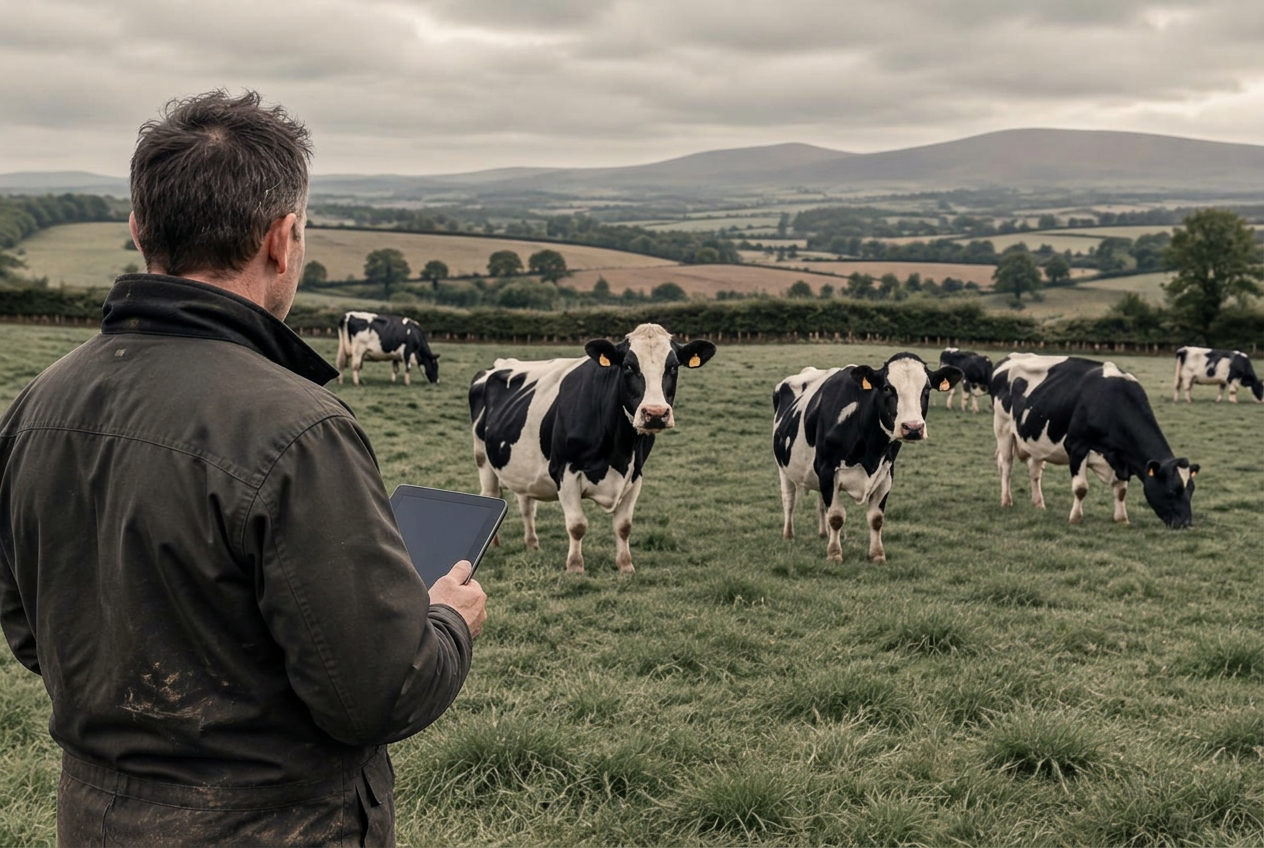
“The tools being built by Irish companies are practical and addressing real problems that farmers face every day.”
Ireland's relationship with the land is ancient, emotional, and deeply embedded in the national identity. But the Irish farm of 2026 looks increasingly different from the one in popular imagination. Alongside the familiar rhythms of calving seasons, grass growth, and milk collection, a quiet technological transformation is underway — one driven not by tractors or fertilisers but by sensors, satellites, algorithms, and machine learning. Artificial intelligence is arriving in Irish agriculture, and the companies leading that charge are, in many cases, Irish startups solving real problems for farmers who have never thought of themselves as technology adopters.
This is not a niche story about innovation for its own sake. Ireland's agri-food sector is worth approximately €15 billion annually, employs tens of thousands of people directly and many more in downstream industries, and sits at the heart of rural Ireland's economic wellbeing. If AI can make Irish farming more productive, more sustainable, more profitable, and more resilient — and the early evidence suggests it can — the implications stretch far beyond the farm gate.
The Companies Building the Future of Irish Farming
The depth of Ireland's agritech sector is striking for a country of this size. A wave of Irish startups — many spun out of universities, many supported by Enterprise Ireland and programmes like AgTechUCD — are deploying AI across every dimension of food and agricultural production.
MooCall, the Dublin company whose tail-mounted sensor alerts farmers by SMS when a cow is about to calve, has built one of Ireland's most recognisable agtech success stories on a single, beautifully practical insight: farmers cannot be in the field at all hours, but they do not want to miss a calving. The algorithm behind MooCall analyses tail movement patterns with claimed 95% accuracy — turning a continuous stream of sensor data into a timely notification that saves stress, saves time, and saves calves.
Micron Agritech, a spin-out from TU Dublin that has raised over €5 million in funding, has developed a portable device for on-site parasite testing in livestock. The AI-based diagnostic system allows farmers to test animals at the farm gate rather than sending samples to a laboratory — cutting the time from test to treatment decision from days to minutes and reducing unnecessary anthelmintic use in a sector under increasing regulatory and environmental pressure to reduce drug inputs.
Cotter Agritech's SmartWorm system takes a similar approach to parasite management in sheep, using algorithms to identify which individual animals actually need treatment rather than blanket dosing entire flocks. The company claims drug use reductions of up to 50% — a figure that matters both for farm economics and for the growing concern about anthelmintic resistance in Irish sheep flocks.
StrongBó Agritech in Galway has built an automated field weighing system for cattle that tracks daily weight gain and feeds the data into a predictive analytics platform. For beef farmers, weight gain is everything — it determines when animals are ready for market and directly drives profitability. Automating that measurement and turning it into forward-looking insights rather than snapshot data is a meaningful step change in how beef enterprises are managed.
Proveye, a UCD spin-out with backing from the European Space Agency, uses AI image analysis of satellite, drone, and ground sensor data to give farmers and land managers remote sensing of crops, grassland, and soil carbon. In a country where grass is the primary agricultural asset and its measurement has historically depended on manual walks and subjective assessment, the ability to monitor grassland growth and quality from above — and to integrate that data into farm management systems — has significant practical value.
Pearson Milking Technology in Kildare has developed what it describes as the world's first pulsator with intelligent real-time diagnostics — its Titan Pulsator uses AI-driven acoustic monitoring to detect equipment faults before they affect cow welfare or milk yield. Its companion Bullseye system uses vision AI to assess cows' body condition score without manual checks, turning parlour cameras into continuous health monitors. As Ross Pearson puts it, AI can "turn constant streams of data into actionable insights" — and in a dairy enterprise where margins are thin and animal welfare directly affects output quality, those insights have real commercial value.
Teagasc and the Research Foundation
Underpinning the commercial activity is a serious research infrastructure. Teagasc, the state's agriculture and food development authority, has been investing in AI and data science applications across its research programmes and has hosted major industry events — including the "Smarter Food: AI for Ireland's Food Industry" event at its Moorepark Food Research Centre — to accelerate knowledge transfer between researchers and industry.
Teagasc Director Frank O'Mara has argued that AI, applied responsibly, can help Irish food firms innovate and compete at a global level — speeding up product development, reducing energy and waste, improving traceability, and enabling Irish producers to reach international markets with higher-value, data-validated products. That last point matters enormously. Irish food exports compete on quality and provenance. AI-enabled traceability and quality assurance systems strengthen that proposition in a world where consumers and retailers increasingly demand verified supply chain data.
Agriculture Minister Martin Heydon has described AI as bringing "massive opportunities" for farmers and the agri-food industry, citing the challenge of feeding a growing global population with fewer inputs and less land as the context in which Irish agricultural innovation must be understood. That framing is important. Ireland's agri-food sector does not just feed Irish people — it feeds the world, with food exports reaching over 180 countries. The innovations being developed in Cork, Kildare, Galway, and Dublin are not just relevant to Irish farmers. They are part of a global response to one of the defining challenges of the coming decades.
The Global Partners Coming to Ireland
The Irish agritech scene is not operating in isolation. Microsoft, IBM, and John Deere are all partnering with Irish research institutions and agtech startups, bringing global scale and resources to the ecosystem. John Deere's presence is particularly significant — the company's investment in precision agriculture technology globally is enormous, and its engagement with Irish research partners signals that Ireland is being taken seriously as an innovation hub in this space, not merely as a market for technology developed elsewhere.
Cropsafe, the Belfast-based farm monitoring platform that uses satellite and weather data with AI interpretation to generate crop disease alerts, raised a $3 million seed round led by US investor Elefund — a sign that international capital is flowing toward Irish and Irish-adjacent agritech companies with real-world traction.
The Challenge of Adoption
For all the innovation at the cutting edge, the challenge of getting AI tools into the hands of the average Irish farmer remains significant. The agritech sector's core problem — identified clearly at the AgTech Ireland conference — is not a shortage of data. Farm and food production data is already being collected in large volumes across Ireland's dairy, beef, tillage, and horticulture sectors. The problem is that the data is scattered, disconnected, and not yet translating into the kind of integrated, actionable farm management tools that can change behaviour at scale.
Enterprise Ireland's Stephen O'Reilly has compared the task facing Irish agritech companies to refining crude oil — the raw material exists, but the process of turning it into something genuinely useful requires significant technical and commercial investment. The companies that crack that challenge — and several are close — will not just build successful Irish businesses. They will build exportable technology that can be deployed on farms from Brazil to New Zealand.
The Bottom Line
Irish agriculture has always been shaped by geography, climate, and tradition. Now it is being shaped by data, algorithms, and artificial intelligence too. From MooCall's calving alerts to Micron's portable parasite diagnostics, from Proveye's satellite grassland monitoring to Pearson's vision AI in the milking parlour, the tools being built by Irish companies are practical, commercially viable, and addressing real problems that farmers face every day. The global food challenge — more people, fewer resources, higher standards — means the market for these innovations is vast. Ireland has the talent, the research infrastructure, the farming tradition, and now the technology to be a genuine world leader in AI-driven agriculture. The transformation is already underway.
AI & Innovation Pulse is an independent Irish digital title covering artificial intelligence and innovation. Every piece is written in-house, editorially independent, and verified.