Flipdish Launches AI Marketing and Restaurant Assistant ToolsAvailable in the UK and Ireland, AI Marketing and Flippy AI target advertising work, business insight and everyday operations.
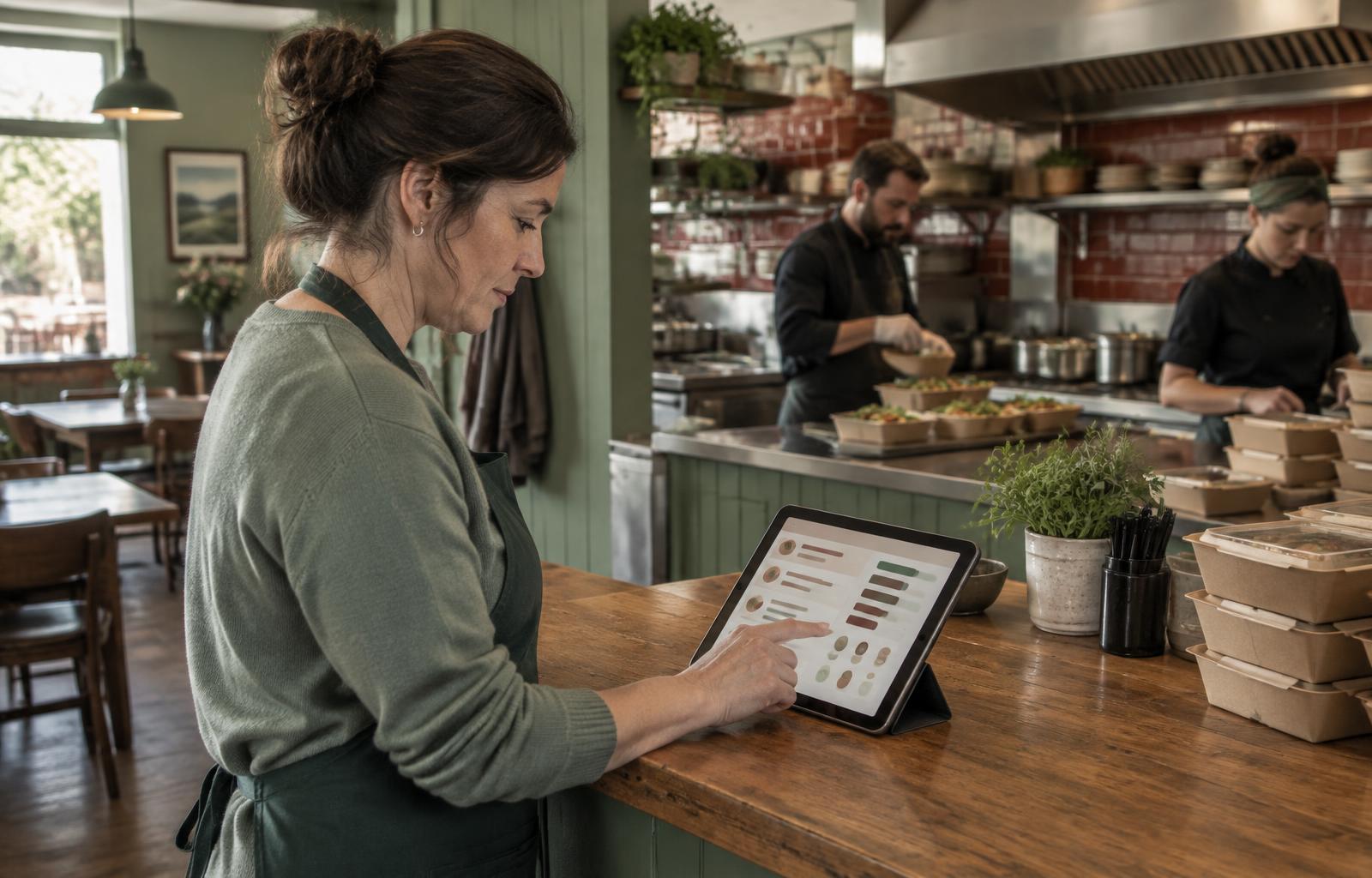
“Restaurant AI earns its place when it reduces management effort while making the business easier for its owner to understand.”
For an independent restaurant, useful AI has to fit around the business of serving food. A tool that requires the owner to become a specialist in advertising or spend longer interpreting reports has missed much of the point. Flipdish's latest launch takes a more practical route: automate parts of customer acquisition and make everyday business information easier to question and act on.
On 14 October 2026, the company announced Flipdish AI Marketing and Flippy AI, saying both were available to Flipdish customers in the UK and Ireland. One focuses on Google advertising and direct orders. The other is a conversational assistant inside the Flipdish App, designed to connect business insights with operational actions.
Together, they present a commercially interesting proposition for smaller operators. Rather than asking restaurants to assemble separate AI experiments, Flipdish is placing these capabilities within its existing product environment. The opportunity is less management friction, with owners retaining responsibility for what the business should do next.
Making local advertising easier to manage
Flipdish AI Marketing creates and manages automated Google Ads campaigns for independent restaurants. According to the launch announcement, it connects marketing with the restaurant's location, menu and website, with the aim of attracting new customers and generating more direct orders. That keeps the proposition close to a recognisable business objective rather than a broad promise of digital transformation.
The company says the product analyses campaign performance daily and adjusts keywords, advertising copy, bidding strategies and tests. These are the kinds of recurring decisions that can make advertising demanding for a time-pressed operator. The intended benefit is to take on that management work without requiring the owner to become a marketing expert.
For a restaurant, the value of automation is partly about attention. Advertising is not a task that can be considered once and then ignored indefinitely. If software handles routine campaign adjustments, an operator can concentrate on judging whether the activity supports the business rather than learning every technical control involved in running it.
The direct-order focus is commercially relevant too. It connects advertising with an ordering destination the restaurant can assess, rather than treating clicks as the final objective. The important question becomes whether spending brings worthwhile business, not simply whether an advertisement attracts attention. That is a stronger basis for a management conversation.
This remains a product proposition, not proof of a universal result. The launch announcement does not establish a measured sales increase for every restaurant using it. Its positive significance is the availability of a tool designed to handle a specialised, recurring task while giving the operator a clearer way to examine what that task produces.
Keeping spending and results visible to the owner
Automation becomes more useful when it does not leave the buyer guessing. Flipdish says operators can use its Portal to track orders, new customers, advertising spend and return on advertising investment. They can also see how campaigns are being improved and manage monthly spending. That visibility is an important part of the offer, not a minor reporting feature.
For a restaurant owner, these measures support different questions. Order data concerns activity generated through the campaign. New-customer information concerns who the marketing is reaching. Spend shows the financial commitment, while return on advertising investment connects that commitment to the reported outcome. Looking at them together is more useful than relying on a single headline number.
The financial judgement still belongs to the operator. Advertising return is not identical to restaurant profit. An owner considering a campaign should also think about food costs, staffing, order capacity and the mix of business it brings. Those are practical evaluation questions, not additional financial benefits that Flipdish has claimed to demonstrate in this announcement.
Visibility also makes it easier to keep automation accountable to business priorities. A restaurant may want growth, but it needs growth it can serve well. The ability to manage monthly spending gives the owner a way to set the scale of the commitment while assessing whether the activity is useful.
This points to a wider lesson for small-business AI products. Removing technical work should not mean removing management control. A strong tool simplifies execution while making its commercial effect easier to inspect. Flipdish's combination of campaign automation and reporting is aimed at that balance: less specialist effort, with a clearer view of the money involved.
Flippy AI connects questions with everyday actions
The second launch, Flippy AI, is a conversational assistant available through the Flipdish App. Flipdish describes it as a command centre for accessing business insights and taking action. The appeal is a single interface through which an operator can ask a question in ordinary language rather than first deciding which report or setting to open.
The examples in the announcement are concrete. Operators can ask about sales performance or seek advice on generating more orders. They can also ask to update opening hours across owned channels and marketplaces, or update a menu to reflect missing items. These are stated product capabilities, not evidence that every customer has used them or achieved a particular improvement.
The combination of information and action is what makes the product interesting. A reporting tool helps an owner see a situation. An operational tool helps change something. Bringing the two closer together could shorten the distance between noticing an issue and dealing with it, provided the operator checks that the proposed action is appropriate.
Opening hours illustrate the practical point. Clear, accurate information matters to customers deciding whether to order. Making an update easier is useful because it addresses a real operational task, not because the conversation itself is novel. The same principle applies to menu information: the business value lies in maintaining the service the customer encounters.
For owners evaluating the assistant, a sensible starting point would be a small set of familiar tasks. They can assess whether the answers are understandable and whether changes match their intentions. That offers a grounded route to adoption, with the owner learning where conversational support is genuinely helpful rather than expecting it to run the restaurant independently.
A Killbarrack customer highlights the value of understanding
The launch includes a useful customer perspective from Mark Nguyen, owner of Orient Express in Killbarrack, Dublin. In the announcement, Nguyen says AI Marketing gives him a clearer picture of what his marketing is doing for the business and a deeper understanding of the results. His emphasis is visibility, not a quantified increase in sales.
That is a meaningful distinction. A business owner needs to understand where value is coming from, not merely receive confirmation that advertisements are running. Nguyen's comments describe that desire directly. They support the case that clearer reporting can matter to an operator, without supplying a measured claim about additional revenue, profitability or customer growth.
Nguyen also expresses interest in how the product develops and an expectation that it will become more effective as it gathers data. That is the customer's forward-looking view, not an established outcome. Keeping those two ideas separate allows the customer experience to be reported positively without turning optimism into evidence.
The broader product strategy is also coherent. Flipdish says the new capabilities build on an offering that began with its AI Phone Agent. With this launch, its AI proposition extends across marketing and daily operations. For an operator, the potential benefit is a more connected set of tools rather than another standalone service to manage.
Availability makes this an immediate purchasing and adoption question. Flipdish said both AI Marketing and Flippy AI were available to customers in the UK and Ireland at launch. Restaurants can therefore assess the products against their own needs now, while distinguishing the company's growth ambitions from the results their individual businesses actually observe.
The Bottom Line
Flipdish's October launch makes a positive case for practical restaurant AI: handle recurring advertising work, make commercial performance easier to inspect and help owners move from a question to an operational action. The products address jobs that matter to a working restaurant rather than asking the business to adopt AI for its own sake.
The strongest customer evidence in the announcement concerns understanding, not a measured sales uplift. That is still a useful starting point. Better visibility gives an owner a firmer basis for decisions. The next test is whether these available tools consistently help restaurants make those decisions with less effort and translate them into business results worth paying for.
AI & Innovation Pulse is an independent Irish digital title covering artificial intelligence and innovation. Every piece is written in-house, editorially independent, and verified.