EU Leaders' Dublin AI Summit: What Came Out of It and What It Means for IrelandEurope's first leaders-level strategic discussion on AI put investment, clean energy, adoption and trust in focus. The next steps matter for Irish businesses, researchers and workers.
“Dublin put AI's economic opportunity and its impact on people in the same conversation. Delivery is the next test.”
Updated 16 November 2026 following the summit's closing statements.
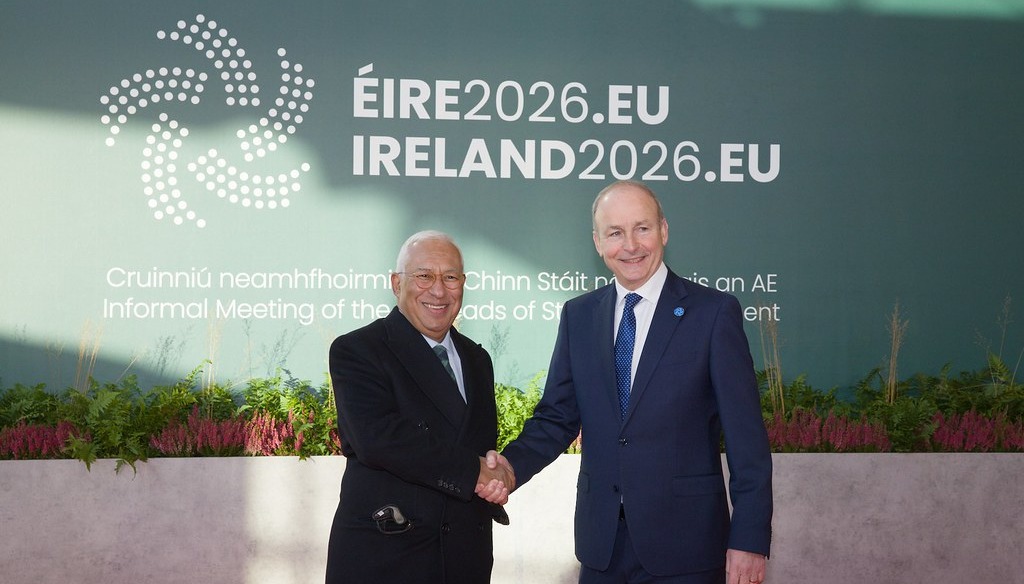
Europe's leaders have now had their first strategic discussion on artificial intelligence, and Dublin was where it happened. The informal European Council at the Convention Centre on Friday 13 November brought AI's economic potential and its effect on society into the same top-level conversation. It followed the European Political Community gathering the previous day, giving Ireland two days at the centre of European discussion.
Chaired by European Council President António Costa and hosted by Taoiseach Micheál Martin during Ireland's Presidency of the Council of the EU, the meeting heard from Mistral chief executive Arthur Mensch and Nobel laureate Geoffrey Hinton. The official account now makes clear what leaders discussed and where the conversation goes next.
This was not the signing of a new AI law or the opening of an Irish funding scheme. It was an informal political discussion, with no formal conclusions adopted. Its importance lies in the priorities leaders put forward: investment, European capability, affordable clean energy, wider adoption and safeguards people can trust.
Why this meeting is different
Europe has talked about AI for years, but mostly through ministers, the Commission and the Parliament. The AI Act, the AI Continent Action Plan and the InvestAI programme all came through those channels. What has not happened until now is the 27 leaders sitting around one table with AI as the main item.
In his invitation letter of 3 November, President Costa explained why a dedicated discussion was needed: the speed of AI's development and its implications for economies and societies. After the meeting, he described AI as "the most important technology of our time", linking higher productivity and better public services to the need for responsible global governance.
That matters because the biggest AI questions are not solely technical. They involve investment, energy, budgets and public confidence, requiring political choices across governments. AI was not the meeting's only subject; leaders also discussed Ukraine. But the dedicated AI discussion gave the technology a place in Europe's wider economic and social priorities.
Two voices in the room: Mensch and Hinton
The two outside speakers helped leaders examine both sides of the AI opportunity.
Arthur Mensch, co-founder and chief executive of Mistral AI, joined the discussion on competitiveness and European AI sovereignty. In everyday terms, that means having more capability within Europe, greater choice over essential technology and less dependence on a small number of outside providers. Leaders examined the investment and infrastructure needed to support that ambition, alongside getting AI used more widely by companies and public administrations.
Professor Geoffrey Hinton joined the discussion on AI's wider effects. The official account records attention to fundamental rights, including children's rights, democratic processes, labour markets, market concentration and cybersecurity. Leaders also discussed international cooperation on the safety of advanced AI. Those are practical questions about how technology is deployed, who remains accountable and how people retain confidence in it.
The meeting did not resolve every question. What it did was place commercial ambition and public responsibility alongside each other, rather than treating them as separate conversations.
What came out of the discussion
The closing account identifies three priorities behind stronger European AI capability: mobilising public and private investment at scale, securing technology value chains and reducing critical dependencies, and ensuring access to clean and affordable energy. Leaders also discussed accelerating adoption throughout the economy.
On funding, Costa said catching up with global peers would require significant additional resources. He highlighted the next EU long-term budget and the proposed European Competitiveness Fund as important to that effort. This points to the budget negotiations as a delivery test; it does not mean money was allocated to Irish projects in Dublin.
He also pointed to the Savings and Investments Union and the proposed "28th regime" as initiatives that could help. The former concerns turning European savings into productive investment; the latter is intended to make operating and scaling across borders simpler. These are wider economic initiatives, not new AI grant programmes created by the summit.
On trust, Costa highlighted Europe's AI Act and the opportunity to help shape global standards from the EU's governance experience. The discussion covered international safeguards for advanced AI that uphold democratic values and fundamental rights. No replacement rulebook or new compliance timetable was announced in the Council's results.
One definite follow-up was announced: AI and its impact on jobs will be the central theme of the 2027 social summit. That meeting will bring together the EU and social partners and mark ten years of the European Pillar of Social Rights. It gives the workforce conversation a named next destination.
What it means for Ireland
For Ireland, the gathering adds a leaders-level discussion to the International AI Summit Dublin hosted in October. They were different events: October's industry and policy gathering should not be confused with Friday's informal European Council. Together, they gave Ireland's Presidency a sustained role in the European AI conversation.
The implications now depend on delivery. For Irish technology companies and university researchers, stronger European capability could mean more opportunities to work with European models, infrastructure and partners. Access will still depend on individual programmes and eligibility; hosting the meeting does not automatically secure an allocation.
For Irish businesses outside the technology sector, adoption is the most immediate message. Useful AI is not only about building a frontier model. It can mean improving a production process, reducing repetitive administration or helping staff find the right information. The sensible starting point is a defined problem, reliable data and a measurable result, with people responsible for checking the output.
The clean-energy priority is also relevant to Ireland's AI infrastructure ambitions. Electricity availability, cost and sustainability are part of the conditions for investment. Dublin's discussion reinforces that connection, but it did not announce a solution to Irish grid or planning questions.
For workers and employers, the 2027 social summit makes skills and job transitions a continuing European priority. Irish organisations can prepare by involving staff early, identifying training needs and deciding where human judgement must remain central. That is a practical way to pursue productivity while maintaining trust.
Where it goes from here
The next test is whether the discussion produces accessible investment, stronger infrastructure and useful adoption. The budget negotiations will show how far Europe backs its ambitions with resources. Subsequent policy decisions and programme announcements will determine what companies and researchers can actually use.
The 2027 social summit provides a confirmed milestone for jobs and AI. Between now and then, the important questions are concrete: which skills employers need, how workers participate in change and what safeguards make new tools dependable. Ireland's Presidency continues until the end of December, leaving time to carry the Dublin conversation into further European work.
The Bottom Line
Dublin moved AI into a strategic conversation among Europe's leaders, connecting investment and clean energy with adoption, safety and jobs. It did not produce a new AI law or guaranteed funding for Ireland. It did establish priorities and a clear follow-up on employment at the 2027 social summit. For Irish businesses, researchers and workers, the opportunity is to turn that direction into practical progress: better access to technology, useful applications and the skills to use them responsibly.
AI & Innovation Pulse is part of The Pulse Network Group, a B2B Media Intelligence Network covering artificial intelligence and innovation. Every piece is written in-house, editorially independent, and verified.