Ireland Built a Quantum Computer That Fits in a Server RackInside Equal1's rise — from Bell-1 to a $60 million raise.
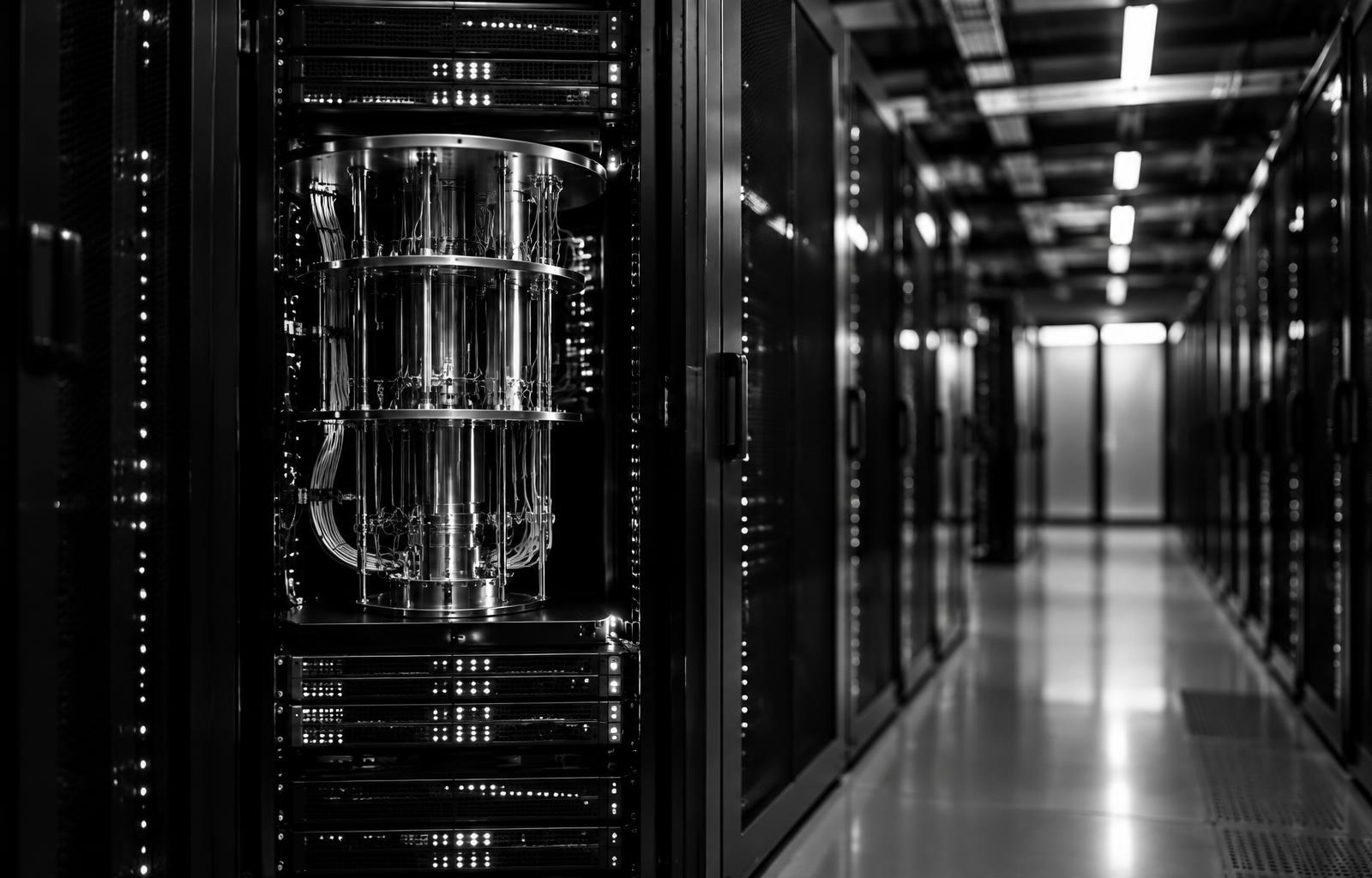
“Most quantum machines need a room of their own. Equal1 built one that needs a slot in a rack.”
Picture a quantum computer and you probably picture something from a science fiction set: a huge golden chandelier of wires and tubes hanging inside a sealed chamber, cooled to a fraction of a degree above absolute zero, looked after by a team of physicists in a specialist lab. For most of the past decade, that picture has been accurate. It is also the single biggest reason quantum computing has stayed out of reach for ordinary businesses.
A Dublin company has spent the last few years quietly trying to change that picture. Equal1, a spin-out from University College Dublin, has built a quantum computer that fits into a standard data centre rack, plugs into normal power and sits alongside the servers companies already run. It is called Bell-1, and it is the first quantum server designed and built in Ireland.
In January 2026 the company raised $60 million to take that idea further. Here is how an Irish start-up ended up with one of the more interesting bets in global quantum computing, and why it matters for Ireland's wider deep tech ambitions.
What Bell-1 Actually Is
Equal1 unveiled Bell-1 in March 2025 at the American Physical Society's Global Physics Summit in Anaheim, California, one of the biggest annual gatherings in physics. UCD described it at the time as the world's first silicon-based quantum computer server, and the launch drew attention well beyond the usual quantum crowd.
The key word is silicon. Most of the quantum computers built by the big players rely on exotic approaches — superconducting circuits, trapped ions or particles of light — each needing its own specialist equipment. Equal1 went a different way. Its qubits, the basic units of quantum information, are built on silicon chips, the same material that sits at the heart of every laptop, phone and data centre on the planet.
That choice has a knock-on effect on everything else. Because the quantum processor lives on a chip made with conventional semiconductor processes, the company can pack the control electronics, the cooling and the processor into one rack-mountable unit. Bell-1 is built to be installed in an existing data centre rather than a purpose-built quantum facility, and to run from a normal power supply rather than an industrial one.
For a company thinking about quantum computing, that is a very different conversation. Instead of asking whether to build a specialist lab, it becomes a question of whether there is a free slot in the rack.
The Bet on Ordinary Chip Factories
The deeper idea behind Equal1 is about manufacturing. The world has already spent decades and trillions of dollars perfecting the art of making silicon chips at enormous scale. Factories in Taiwan, the United States, Europe and, closer to home, Leixlip in County Kildare turn out billions of transistors with astonishing precision every day.
Equal1's argument is that quantum computing does not need to reinvent all of that. If qubits can be made on silicon using standard semiconductor processes, then quantum chips can ride on the back of the global chip industry — its factories, its supply chains, its skilled people and its decades of know-how. That is the thinking the company leaned on when it announced its latest funding, framing the raise explicitly around accelerating quantum computing using existing semiconductor manufacturing.
It is a practical, engineering-first way of looking at a field that is often discussed in purely scientific terms. Many experts agree that the hardest part of quantum computing is no longer proving it can work in a lab, but scaling it up reliably and affordably. A route that borrows the chip industry's scale is one of the more credible answers to that problem on the table.
The approach also fits neatly with where Ireland is already strong. The country has spent more than four decades building a semiconductor cluster, and silicon-based quantum computing sits right at the point where that cluster meets the next wave of computing.
The $60 Million Vote of Confidence
On 15 January 2026, Equal1 announced it had raised $60 million, or around €51.5 million. The round was led by the Ireland Strategic Investment Fund, the State's sovereign development fund, with Enterprise Ireland also publicly backing the company. The raise brought Equal1's total funding to more than $85 million.
The size of the round matters. Deep tech companies — businesses built on hard science rather than apps — often struggle to raise money once they move beyond the early stages, because their products take longer and cost more to build. For an Irish quantum company to close a round of this scale is a strong signal that serious investors see real commercial potential in the silicon route.
ISIF's lead role is telling, too. The fund invests on a commercial basis while supporting economic activity and jobs in Ireland, so its backing is both a financial bet and a statement that quantum hardware is something the country wants to build here rather than simply buy in from abroad.
Equal1 has said the new funding is aimed at accelerating its technology and bringing its quantum systems to more customers. For a company whose whole pitch is about making quantum computing easier to deploy, the next few years are about proving that pitch in real data centres, with real workloads.
Why It Matters for Ireland
Equal1's story lands at a useful moment. In July 2026 the Government published its implementation plan for Quantum 2030, Ireland's national quantum strategy, setting out concrete steps for the year ahead. Cork's Tyndall National Institute has been named as a partner in P4Q, a €50 million European project on photonics for quantum. And the country's semiconductor strategy, Silicon Island, is now more than a year into delivery.
Against that backdrop, Equal1 gives the national conversation something it has sometimes lacked: a homegrown company with a real product, real investors and a clear commercial story. Strategies set direction, but companies like Equal1 are what turn direction into jobs, exports and expertise.
It also shows what the long game in Irish research can produce. Equal1 grew out of UCD, drawing on years of university work in chip design and quantum engineering. That journey — from a university lab to a product unveiled on an international stage to a major funding round — is exactly the pipeline Ireland's research and enterprise agencies have been trying to build.
None of this means quantum computing will be sitting in every Irish server room next year. The technology is still maturing, and the most valuable real-world uses are still being worked out across the industry. But the direction of travel is clear, and an Irish company is helping to set it.
There is also a bigger point about ambition. For years, the assumption was that the most important quantum hardware would come from giant technology companies in the United States or China. Equal1 shows that a focused Irish team, with the right idea and the right backing, can compete on the global stage and be taken seriously by international investors and scientists alike.
That confidence matters for the next generation of founders. Every successful deep tech company makes it easier for the one that follows to raise money, hire people and win customers. Equal1's progress gives Irish researchers a real, local example of what is possible when university science is turned into a product with a clear market.
For data centre operators, cloud providers and research institutions, the attraction is obvious. A quantum system that installs like a server lowers the cost and complexity of experimenting with the technology, which is exactly how new computing platforms tend to spread: first to early adopters, then to everyone else.
The Bottom Line
Equal1 has taken one of the most intimidating technologies in the world and asked a refreshingly ordinary question: what if it just fitted in a rack? Bell-1, unveiled in March 2025, is Ireland's first quantum server, built on silicon and designed for the data centres businesses already use. The $60 million raised in January 2026, led by ISIF, gives the Dublin company the runway to prove that idea at scale. For Ireland, it is a rare and welcome thing — a deep tech company with a world-class idea, strong backing and a genuinely Irish story, right at the point where the country's chip heritage meets the future of computing.
AI & Innovation Pulse is an independent Irish digital title covering artificial intelligence and innovation. Every piece is written in-house, editorially independent, and verified.