Helping Robots Handle the Unexpected: Ireland's Role in CoreSenseA completed European research project involving Irish Manufacturing Research has developed software and demonstrations for robots that can respond better when tasks change.
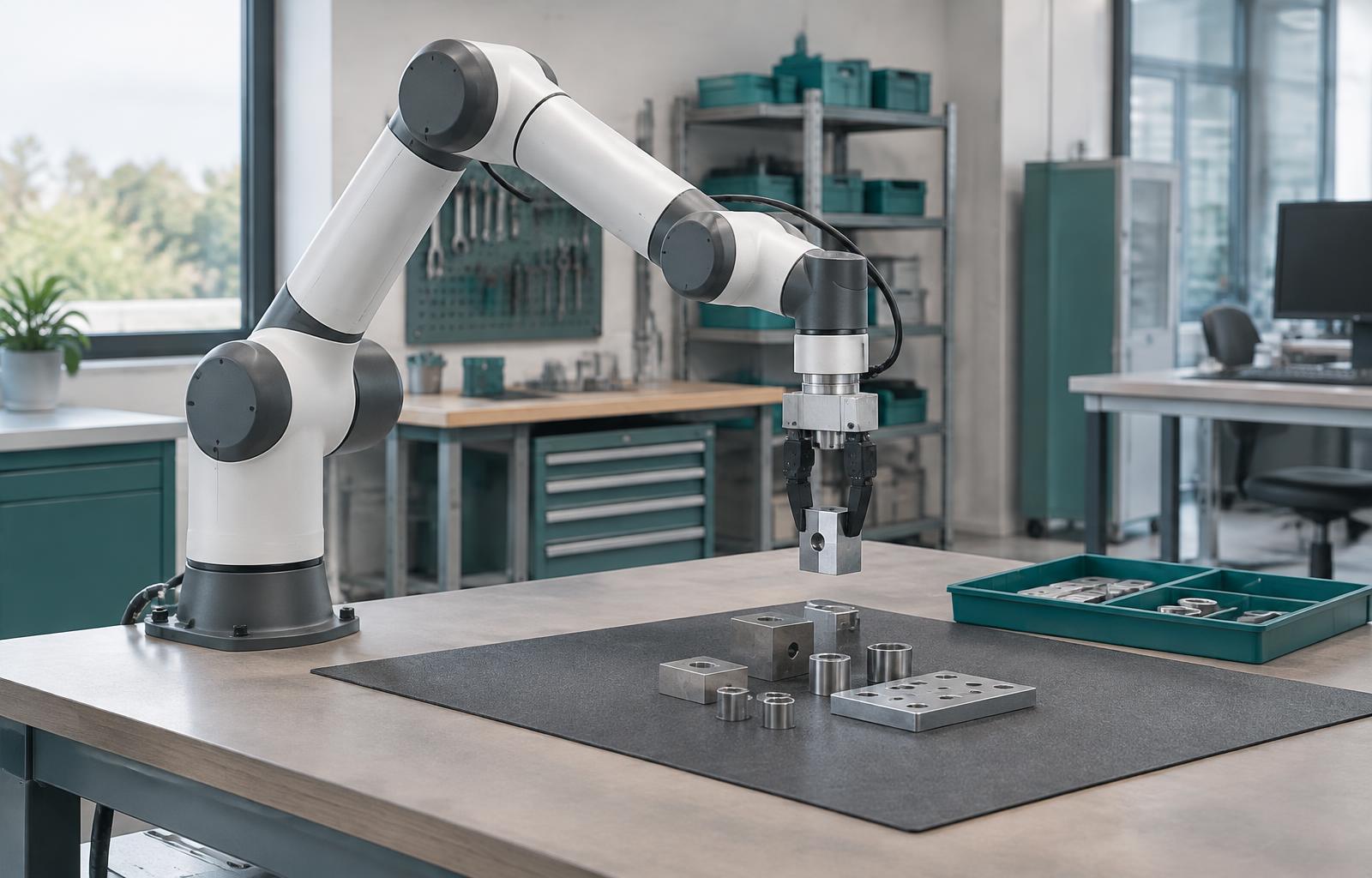
“The harder question is what happens when something changes.”
A robot working in a carefully prepared environment may be very good at repeating a task. The harder question is what happens when something changes: a different tool is needed, a defect appears or another machine runs into trouble. CoreSense, a European research project involving Irish Manufacturing Research, has been exploring how robots can cope better with those situations.
IMR reported the project's conclusion in a September announcement, and the European Commission's project record gives its formal end date as 30 September 2026. The four-year programme brought together seven partners and developed research, software and demonstrations aimed at more adaptable and explainable robotic systems. Its focus was the intelligence around the machine, rather than a single new robot available to buy.
That makes the Irish connection worth examining. Ireland participated in a shared European effort addressing a practical automation problem: how to make robots useful when the environment does not follow a perfectly predictable script. The results offer material for further development and potential industrial use. They do not yet establish a widespread commercial rollout.
Why Changing Conditions Matter
Industrial automation works best when tasks and surroundings are understood. If the expected conditions change, a system may need a different plan or help from a person. CoreSense set out to investigate methods for making that response more structured: helping a robot represent what is happening, recognise relevant changes and choose behaviour that fits the situation.
The project uses terms such as understanding and awareness. In this context they refer to engineering models and information processing, not a claim that robots have consciousness. A machine can maintain a useful description of its environment without experiencing that environment as a person would. Keeping those meanings separate makes the research easier to understand and avoids giving software human qualities it has not demonstrated.
IMR describes a reusable cognitive architecture and an open-source software toolbox among the outputs. An architecture is the organised structure connecting different functions; a toolbox supplies software that developers can build on. The ambition is to make the approach usable beyond one tightly customised demonstration. That is an important direction for research intended to influence multiple robot platforms.
For an Irish manufacturer, the attraction is practical. A system that deals more effectively with changes could be useful where work varies, where exceptions arise or where people need a clearer account of why a machine acted in a certain way. CoreSense does not provide a verified percentage reduction in downtime or a guarantee of safety in every setting. It supplies methods and reported demonstrations that can be evaluated against those needs.
There is a useful distinction between flexibility and unpredictability. The goal is not to let a robot improvise without limits, but to give its response to changing conditions a clearer structure. For people overseeing automation, an account of what the system understood and why it selected an action can make evaluation more meaningful. That is a reason to examine explainability alongside task performance, rather than treating it as an optional addition after a machine has been introduced.
Three Settings Show the Research in Practice
The consortium's manufacturing testbed explored robots dealing with new tasks, tool changes and unexpected defects. Those examples are more concrete than a general promise of smarter automation. They concern what a robot does when its original assumptions no longer describe the work. The project reports demonstrate the intended application, while further evidence would be needed to establish performance across different commercial factories.
A second testbed involved drone inspection. IMR describes shared awareness helping a team continue its mission when an individual drone encounters problems. That makes coordination part of the research question. A group of machines needs information about the task and about one another if it is to respond usefully when the team's circumstances change.
The third setting was social robotics: a service robot carrying out domestic tasks while responding to human needs and making its reasoning more visible. A domestic environment differs substantially from a production line. The variety of tasks and interactions gives the researchers another way to examine whether their approach can be applied beyond a single industrial routine.
These are research testbeds, not an announcement that the resulting systems are now installed in homes, factories and inspection businesses at scale. Their value is that they connect the same broad engineering approach to different practical situations. Together they illustrate why adaptability and explanation matter, while leaving commercial readiness to be assessed through further work.
What the Programme Leaves Behind
CoreSense was coordinated by Universidad Politécnica de Madrid. Alongside IMR, the partners named in its conclusion announcement included TU Delft, Fraunhofer IPA, Universidad Rey Juan Carlos, PAL Robotics and Czech Technical University. The European Commission records a total project cost and EU contribution of approximately €5.41 million. That is consortium-wide funding, not an amount awarded solely to the Irish partner.
IMR reports 18 academic articles and 22 conference papers, in addition to software and engineering outputs. The Commission's results record includes architecture specifications, theories of awareness and understanding, testbed requirements and development guidelines. The documentation matters because it gives the work a life beyond a final announcement: other researchers and developers have material against which to examine the approach.
Open-source availability is another route for continuing the work. IMR says ROS-compatible software remains available through GitHub. ROS is a widely used software ecosystem for robotics, so compatibility can help developers connect research tools to existing workflows. Availability does not automatically establish production readiness, long-term maintenance or suitability for every commercial application. Those are separate questions for users of the software.
The combination of demonstrations, publications and reusable tools is stronger than an isolated concept presentation. It gives the project several forms of output: a proposed way to organise robot intelligence, evidence of its use in selected settings and resources for further investigation. That is the appropriate level at which to recognise the achievement of a completed research programme.
The Route From Research to Industrial Use
The conclusion announcement describes possible commercialisation routes, including a potential spin-off and integration into commercial robot platforms. Those are options under exploration, not completed deals. It also refers to planned contributions to standards work. A research contribution to that discussion is different from an adopted standard or a certification issued to a product.
The next stage requires matching the tools to specific operating needs. A factory, inspection company or robot supplier would have to assess whether the approach fits its task, equipment and oversight requirements. An adaptable system still needs well-defined limits and ways for people to intervene. Better explanations can help users understand behaviour, but explanation alone does not prove that every decision is correct.
That provides a constructive Irish angle. IMR's participation places an Irish research organisation within a European network developing transferable robotics methods. It does not mean IMR invented every element or hosted every demonstration. It does show involvement in work that connects advanced software with manufacturing and other real-world tasks, with results available for continued examination.
The most useful measure of future progress will be what happens to those outputs: whether developers use them, whether integrations are demonstrated and whether the commercial routes described become concrete. The September conclusion is therefore a milestone in the transfer of research, not the end of the story. The programme has created a basis on which the next practical steps can be built.
The Bottom Line
CoreSense has produced research tools and reported demonstrations addressing a clear robotics challenge: responding when circumstances change and making behaviour easier to understand. Irish Manufacturing Research was part of the seven-partner European effort, whose formal work ended in September. The positive story is a documented platform for further development, not a ready-made promise of universal robot autonomy. Commercial integration remains a next step, with adaptability, oversight and measured performance the important tests.
AI & Innovation Pulse is an independent Irish digital title covering artificial intelligence and innovation. Every piece is written in-house, editorially independent, and verified.