AI at Work in Ireland: 43% of Private Sector Firms Now Use AI ToolsFrom pilot projects to daily routine: how AI is becoming a normal part of the Irish working day.
“AI adoption in Ireland is above the EU average.”
Not long ago, AI in the workplace meant a handful of experiments run by innovation teams. In 2026, for a large share of Irish organisations, it simply means Tuesday.
Trinity College Dublin's AI Economy Report 2026, produced with Microsoft Ireland, surveyed 250 organisations in the Republic of Ireland. It found that AI adoption in Ireland is above the EU average. In the private sector, approximately 43% of organisations reported that AI tools are already implemented and in active use. In the public sector, the figure was around 36%.
Those numbers tell a clear story: AI has moved out of the lab and onto the desk. Here is how Irish workplaces are actually using it, what is helping them succeed and what comes next.
What the Numbers Show
The Trinity research gives one of the clearest pictures yet of how far AI has spread in Irish organisations. Its central finding — that Ireland is ahead of the EU average — is consistent with other 2026 research pointing to Ireland as one of Europe's strongest AI performers.
The Expert Group on Future Skills Needs, in its June 2026 paper on the Irish labour market and AI, described a rapid rate of AI diffusion across the economy. It found that Ireland is generating AI jobs at two to three times the pace of peer countries and ranks second in the EU for AI skills.
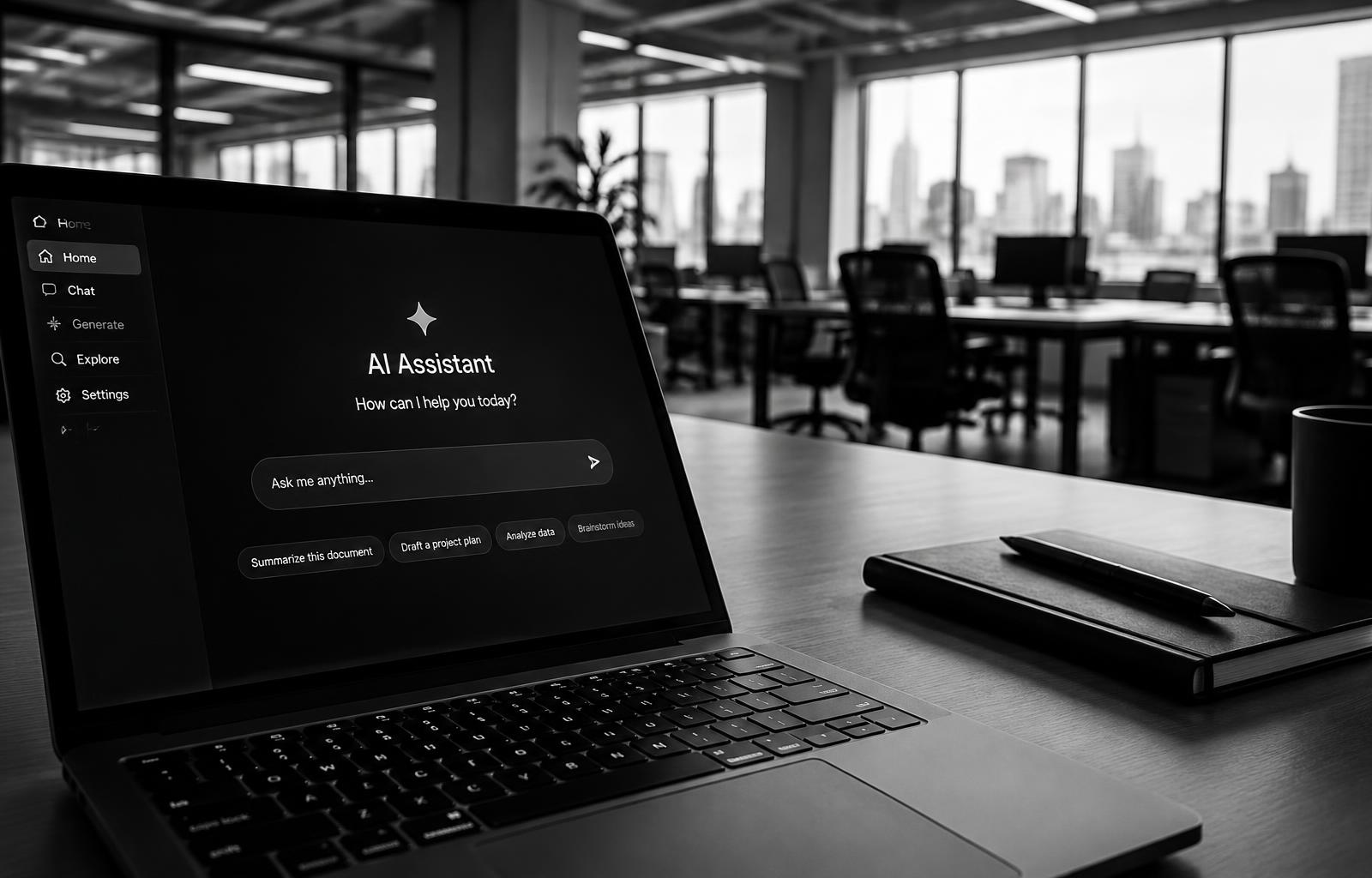
The Trinity report also notes that day-to-day use of AI tools, particularly generative AI, has become widespread. Many workers now use AI assistants to draft emails, summarise documents, analyse data, prepare reports or brainstorm ideas — often several times a day.
The public sector figure of around 36% is also worth highlighting. Public bodies tend to move more carefully with new technology, for good reason, given their responsibilities around data and public trust. Seeing more than a third already using AI tools shows that adoption is reaching every part of Irish working life.
How Irish Workplaces Are Using AI
In practice, most workplace AI in Ireland today is about helping people do their jobs better rather than replacing them. The most common uses are practical and everyday.
In professional services, AI tools help lawyers, accountants and consultants review documents, research questions and draft first versions of reports. In customer service, AI supports agents with suggested answers and quick access to information, helping them resolve queries faster. In marketing, teams use AI to generate ideas, test messages and analyse campaign results.
In manufacturing and life sciences, two of Ireland's most important sectors, AI is being used for quality control, predictive maintenance and speeding up research. In finance, it helps with fraud detection, risk analysis and reporting. In software development, AI coding assistants have become a standard part of many engineers' toolkits.
The common thread is that AI takes on repetitive, time-consuming tasks, freeing people to focus on judgement, creativity and relationships — the parts of work that people generally value most.
Increasingly, organisations are also exploring more advanced uses, including AI agents that can carry out multi-step tasks on a person's behalf. These are still at an earlier stage, but they point to where workplace AI is heading next.
Skills, Trust and People First
The organisations getting the most from AI tend to have one thing in common: they invest in their people. Research from Digital Business Ireland in 2026 found that a lack of skills or training is the biggest factor limiting AI use at company level. The technology is available — the challenge is helping people use it confidently and well.
Skillnet Ireland's September 2026 report, Right Sizing AI at Work, looked at exactly this question. It examined how AI and machine learning are reshaping jobs, skills and human-machine collaboration in Ireland, and highlighted the importance of enterprise-led approaches to workforce development. It also noted Ireland's strong emphasis on digital skills, lifelong learning and enterprise support.
In practical terms, that means companies running training sessions, setting clear guidelines on how AI should and should not be used, and encouraging staff to share what works. It also means being thoughtful about data, privacy and accuracy, so that people can trust the tools they use.
State-funded programmes help here too. Springboard+ 2026 offers 7,274 places across 244 courses, many in digital and AI-related areas, while Skillnet Ireland networks deliver subsidised training for businesses of every size.
The EU AI Act adds a further layer, setting out rules for how AI systems are used in the workplace. For Irish organisations, building good governance now is not only a legal requirement — it is also a way to build trust with staff and customers.
How It Is Actually Going Now
Taken together, the 2026 research paints an encouraging picture. AI is already part of daily working life in a large share of Irish organisations, adoption is ahead of the European average and the workforce is building the skills needed to use it well.
The next phase will be about depth rather than breadth. Many organisations have started using AI tools; the opportunity now is to move from individual use to redesigning whole processes around AI, in a way that makes work more productive and more rewarding.
That will be especially important for small and medium-sized businesses, which make up the backbone of the Irish economy. Helping them adopt AI with confidence, through training, advice and practical examples, could deliver some of the biggest gains of all.
For workers, the message is positive. AI is becoming a tool that helps people do more interesting work, not a threat to be feared. Those who learn to use it well will be well placed for whatever comes next.
Getting Started: Practical Lessons From Early Adopters
For organisations still at the beginning of their AI journey, the experience of early adopters offers some useful lessons. The first is to start small and practical. Rather than trying to transform everything at once, many successful organisations began with one or two clear use cases, such as summarising meeting notes or speeding up the drafting of routine documents, and built from there.
The second lesson is to involve staff from the beginning. People are far more likely to embrace AI when they help choose how it is used and can see how it makes their own work easier. Organisations that treat AI as something done with their teams, rather than to them, tend to see faster and more positive adoption.
The third is to set clear guidelines. Simple rules on what information can be shared with AI tools, how outputs should be checked and when a human must make the final decision go a long way towards building trust and avoiding mistakes.
The fourth lesson is to measure what matters. Tracking the time saved, the quality of the work produced and how staff feel about the tools helps organisations understand where AI is genuinely adding value and where it needs adjusting.
Finally, early adopters stress the value of learning from others. Industry networks, Skillnet Ireland programmes, Enterprise Ireland supports and university partnerships all give Irish organisations ways to share experience and avoid reinventing the wheel. For smaller businesses in particular, those networks can make the difference between hesitating and getting started.
None of these lessons require a large budget or a dedicated technology team. They depend on curiosity, clear thinking and a willingness to try new ways of working — qualities Irish organisations have in abundance. The organisations that start now, however modestly, will be best placed to benefit as the tools continue to improve.
The Bottom Line
Trinity College Dublin's AI Economy Report 2026 found that around 43% of Irish private sector organisations and around 36% of public sector bodies now have AI tools in active use, with Ireland ahead of the EU average. Backed by strong skills, growing training supports and a people-first approach, AI is fast becoming a normal part of the Irish working day — and the organisations investing in their people are seeing the biggest benefits.
AI & Innovation Pulse is an independent Irish digital title covering artificial intelligence and innovation. Every piece is written in-house, editorially independent, and verified.